Concept and proposal
Conceived MINI-X, developed the initial research direction, and sought the two supervisors whose expertise the project required.
Original concept · MSc thesis · First-author AAS/AIAA paper
I conceived and proposed MINI-X, a five-spacecraft mid-infrared nulling-interferometer precursor to LIFE, and I lead its end-to-end technical development.
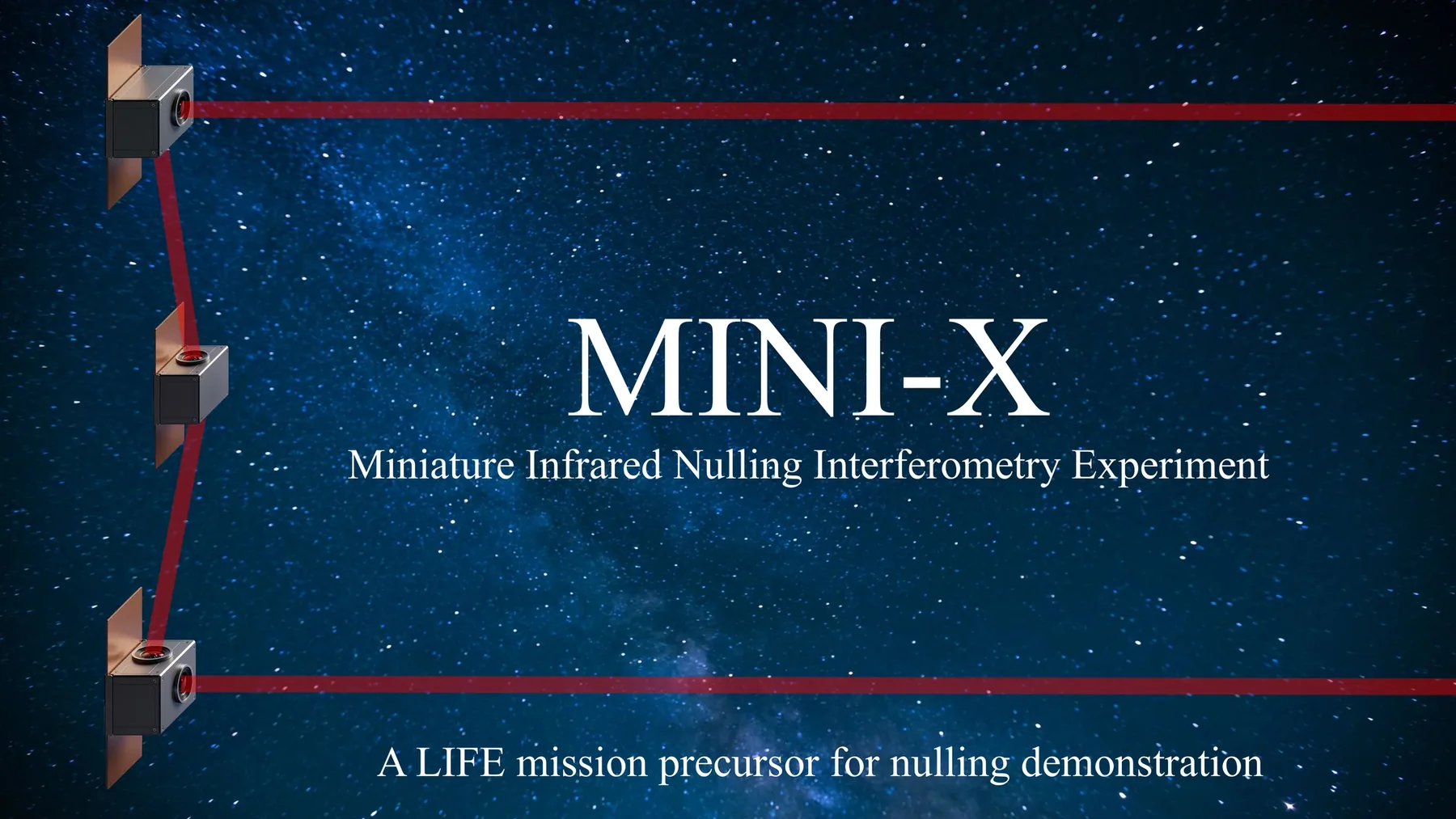
Project overview
MINI-X (Miniature Infrared Nulling Interferometry Experiment) began with a concept I developed and proposed for my MSc: use a smaller formation-flying interferometer to retire some of the dynamics, control, and science-performance risks that matter to LIFE.
After defining the initial concept, I approached Dr. Sarah Rugheimer for her expertise in exoplanet science and LIFE, and Dr. Michael Bazzocchi for his expertise in spacecraft control. They agreed to supervise the project, which now places me in both the Exoclimateers and ASTRO Lab.
I lead the concept, architecture, simulation, controller development, trade studies, science-performance interfaces, and publication work. My supervisors provide the exoplanet-science and controls expertise that guides the research. MINI-X is a five-spacecraft interferometer, and my first-author 2026 paper documents its 144-case formation-control study.
My contribution
Conceived MINI-X, developed the initial research direction, and sought the two supervisors whose expertise the project required.
Built the Basilisk simulation, implemented the formation-control approaches, and now connect GNC residuals to optical path difference, tip/tilt, null depth, SNR, and detection yield.
Designed and analyzed the 144-case study and reported it in my first-author AAS/AIAA paper; the project is now expanding into optics-aware control and robotic hardware-in-the-loop validation.
Principal findings
Moving from the PD baseline to the LQI controller reduced the position-error metric by roughly fourteenfold.
Out-of-plane beam-combiner placement incurred 3.41 times the propellant use of the in-plane alternative in the evaluated architecture.
A structured matrix separated controller performance from formation rotation and beam-combiner placement effects.
Interactive result explorer
Select an option to see the published headline metric. Bars are normalized within each comparison; they do not compare millimetres with propellant.
PD establishes the conventional control baseline.
In-plane placement is the normalized propellant baseline.
PD controller selected: 22.68 millimetres. In-plane geometry selected: 1.00 times relative propellant.
Method
Model the observatory near Sun–Earth L2 with the dynamics needed to expose relative-motion and control demands.
Use six-degree-of-freedom rigid-body dynamics with actuator behavior and state-estimation effects.
Evaluate a conventional PD baseline against an LQI design derived for the CR3BP-relative dynamics.
Vary rotation behavior and beam-combiner placement across the full case matrix.
Measure formation-position error and propellant consumption for each case.
Research record
Weatherbee, A., Rugheimer, S., & Bazzocchi, M. C. F. “Sun–Earth L2 Point Nulling Interferometry Formation Flying Performance Analysis.” AAS/AIAA Astrodynamics Specialist Conference, Whistler, BC, 2026. Paper AAS 26-967.
Study scope
The reported values are architecture-study metrics from the simulated cases. The paper documents the model, configuration assumptions, and primary results.